
01 — The problem
The problem
For an adult with a developmental disability, a great deal of daily life is often held together by someone else — often a parent. The appointments, the medication, the money, the bus, the forms. It works — until it doesn't. Parents grow old. The arrangement was never going to be permanent, and everyone inside it knows that.
Independent Living Skills — ILS, in the language of California's developmental-services system — are the competencies that decide how an adult does when that arrangement ends: managing a day, a budget, a task, a trip, a conversation. They are not enrichment. They are the difference between a life a person runs and a life that runs short of help.
Two things made teaching those skills harder, fast. The first: the skills themselves now run through AI. Planning, finding, drafting, deciding, booking — the everyday tools the rest of the world is quietly learning. Adults with developmental disabilities, who already have fewer learning opportunities once school ends, were on track to be left furthest behind the very tools that could help them most.
The second is the teaching. Programs for this audience tend to fall into one of two traps.
Trap one
Aim high — teach real technology skills the way you'd teach anyone — and the abstraction overwhelms; the learner meets failure often enough to stop trying. That is learned helplessness, and it is how these programs lose people.
Trap two
Aim safe — teach the basics wrapped in cartoon mascots, rainbows, and gold-star praise — and a thirty-five-year-old is handed what looks like a child's worksheet. It is gentler, and it quietly costs something: it tells an adult, every single lesson, that they are not one.
Seesaw — a nonprofit that serves these adults every day — came to IT ABLE because neither trap was acceptable, and the clock was not theoretical.
02 — The approach
The approach
The starting question was not how do we teach AI. It was: what would actually let an adult with a developmental disability run their own life — and could the same answer fix the teaching problem too?
It could, because of one observation. The places these learners need the most support — holding several steps in mind, getting started, planning ahead, checking their own work — are exactly the places a modern AI assistant is strong. A wheelchair ramp doesn't walk for anyone; it removes the barrier that stopped them. AI can be a cognitive ramp in the same way. Which means using AI well is not a separate subject from independent living. For this learner, it is independent living. Teaching the skill and teaching the tool became one curriculum.
That settled what to teach. The harder design problem was how — without falling into either trap. The curriculum is built on three decisions.
The curriculum looks and behaves like software a working adult uses — a dark dashboard, not a classroom. The learner is a Manager; a lesson is a briefing; finishing is an approval, logged. No mascots, no gold stars. Behind that professional surface, the actual material is the learner's own life: cleaning a room, planning a meal, managing money, catching a bus, taking medication. Nothing is invented to be "educational" — every lesson is something the learner will do again next week. The form says you are an adult; the content stays useful tomorrow.
Abstract numbers are where this audience is most often shut out, so the curriculum routes around them. A budget is two bars to compare, not a subtraction. Checking the cupboard is a photo of a full shelf beside a photo of an empty one. The judgment the learner makes is real; the arithmetic barrier in front of it is gone.
Underneath the lessons is a framework IT ABLE developed — the company's core intellectual property. It names the five executive-function skills every lesson is designed around — planning, working memory, self-monitoring, flexible thinking, getting started — and it defines an assessment instrument, the AI-EFS Index, that lets an instructor record where a learner stands on each one instead of guessing. The curriculum is not a set of activities. It is a method, written down.
03 — What we built
What we built
IT ABLE developed this AI-based ILS curriculum for that partner nonprofit, and it runs in their classrooms today. It is delivered as software — each week a self-contained interactive app a class works through together, every week the same shape: a warm-up, two skill-building activities, and a Field Ops session, the hands-on part where the learner uses a real AI tool.
The core course, Smart Life Management, is mapped across a full year — forty-eight weeks, four quarters, from a learner's first contact with AI through a final capstone project. Ten of those weeks are live and in class now, with more built and rolling out. Alongside it: Bio-System Management, an eight-week course on the body — nutrition, health habits, everyday self-care — and Digital Ethics, simulation-based learning on safe and respectful conduct in digital life. A prerequisite course, AI Foundation, is designed and in development.
AI shows up in the lessons two ways, and both are deliberate.
In the early weeks it is woven straight into the activity. A learner building their digital ID card answers a few questions about themselves, and the app calls AI to draft a short, professional bio line and generate the card's colors and styling — the learner art-directs, the AI renders. In a lesson on reading emotion, the app sends a set of facial expressions to AI and gets back a gentle, plain-language read. Nobody is taught about AI from a slide; in the first hour, a learner watches it do real work on their own material.
In later weeks the learner drives the AI directly, in a section called Field Ops. Typing a prompt from a blank box is a wall for many of these learners, so the wall is removed: they tap to choose — a role, a task, a format — and the app assembles a clean, complete prompt. They run it on a real AI tool and bring the result back. It is genuine prompt construction, with only the typing barrier gone.
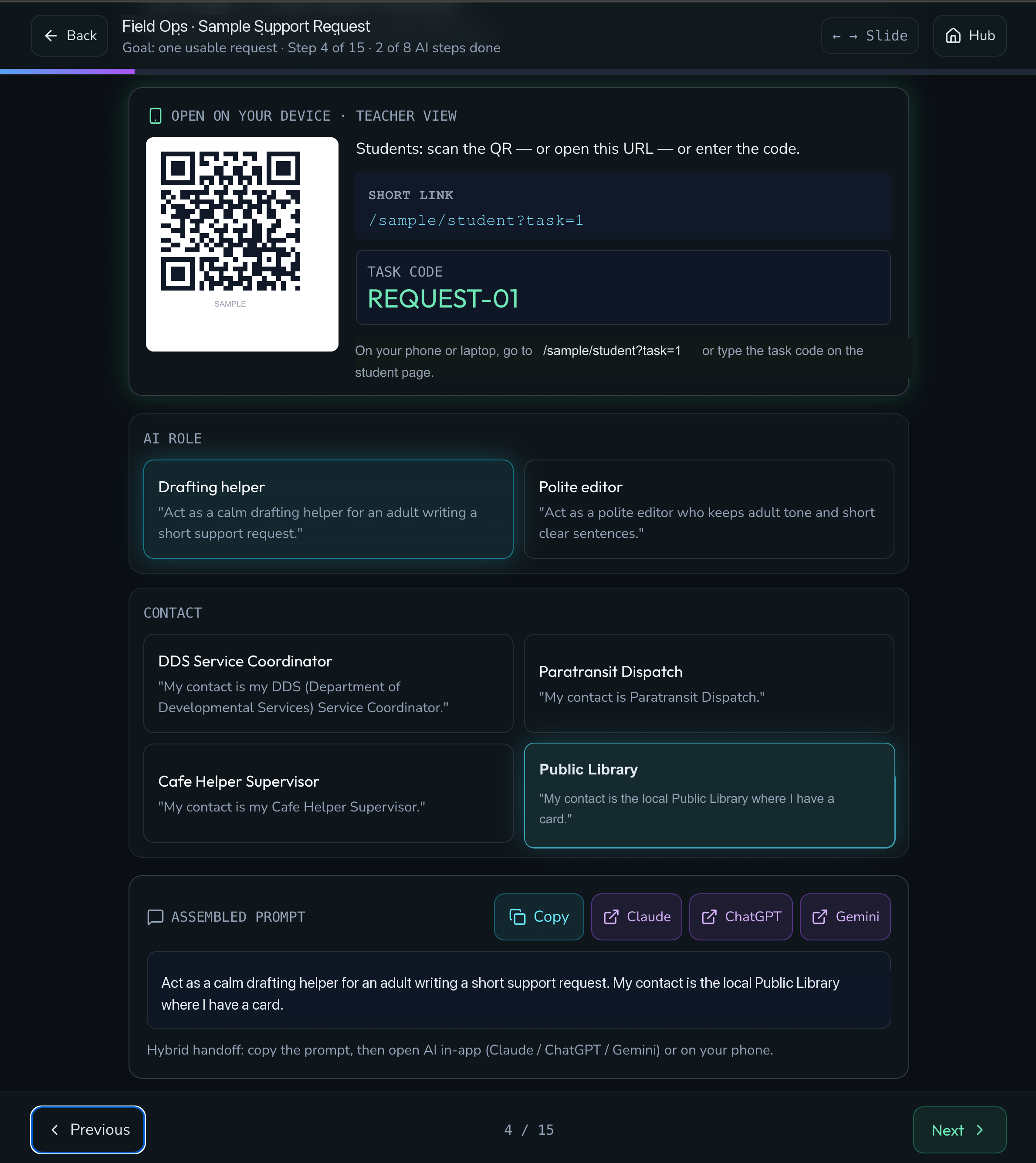
All of it runs on a learner portal IT ABLE built and maintains, with a separate dashboard for instructors — used to invite learners, set what each one can reach, and shape an individual learning path. The curriculum is licensed to the partner nonprofit, which delivers it to the adults in its programs.
04 — A closer look
A closer look — the modules parents asked for
Two of the modules did not begin as a curriculum plan. They began with parents — different families, raising the same fear, about the years when they will no longer be in the room. Each one takes on something hard to teach and dangerous to skip.
Module
Digital Ethics.
Adults with developmental disabilities live in the same digital world as everyone else — group chats, dating apps, a job with coworkers. Much of what keeps that world safe and workable runs on unwritten rules — the kind most people absorb without ever being taught them. Many of these adults never got that chance.
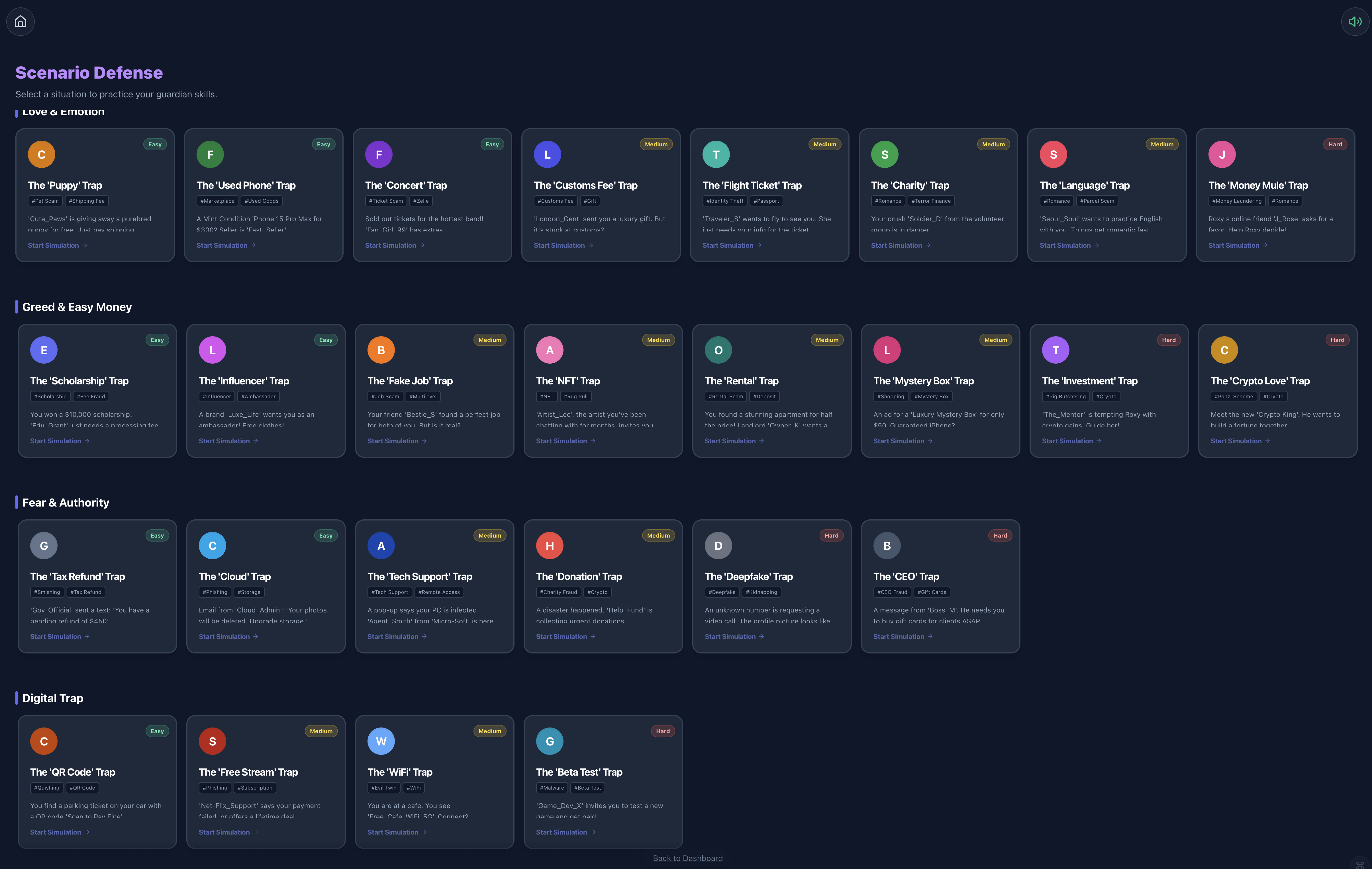
So Digital Ethics teaches it directly, as simulation-based learning. The learner works through realistic situations, set in adult places rather than a classroom, and practices — safely — the judgment those situations ask for: what to share and what to keep private, how to notice when something is wrong, how to treat other people well online and be treated well in return. It is a place to build that judgment before it is needed for real.
Module
Bio-System Management.
When the parent who booked the checkups and kept the kitchen running is gone, an adult has to look after their own body. And looking after a body is a skill — learned, like any other. Most people absorb it, with someone nudging them along the way. Many of these adults got neither. The stakes are not small: eating well, sleeping enough, staying active, noticing when something is wrong, keeping up the everyday care a body needs — the things a person now has to keep up for themselves. And a body keeps its accounts in private; the bill for this month's choices does not arrive this month.
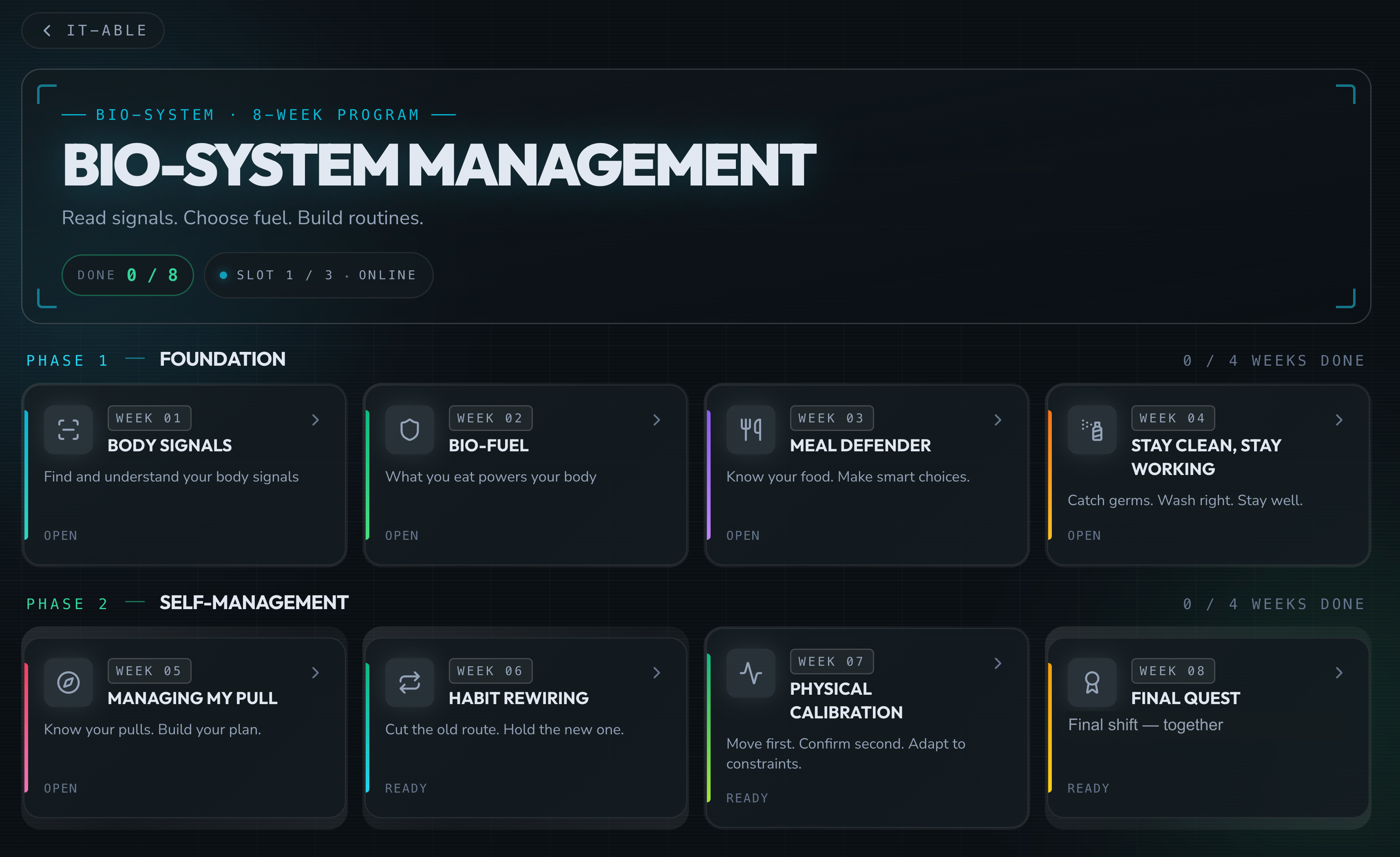
So Bio-System Management does something unusual: it makes a body legible. It casts the learner not as a patient but as the trained operator of a system that happens to be their own. The body becomes a dashboard of gauges; food becomes fuel; sleep and hygiene become maintenance; an organ under strain becomes a reading the operator can watch and act on. Across eight weeks it moves from reading the body's signals to fuel and meals, to impulse and habit, to movement. Reframed this way, a hard fact arrives with a control panel attached — which is what makes it possible to face.
It also had to solve something Digital Ethics did not. A digital consequence can be shown the moment it lands; a health consequence, in real life, takes months to surface. So the course built a what if the instructor triggers by hand: the screen jumps three months ahead, then further, and shows the cost the body had been quietly adding up. It is the same principle — meet the hard truth here, once, safely — tuned for a slower danger, and kept in the instructor's hands so it never loses its edge.
Independence is never one skill. It is a hundred small ones — and the ones that matter most tend to be the ones a parent quietly carried. Digital Ethics and Bio-System Management are where the curriculum hands those back. Both are live, in use in the program today.
05 — Where it stands
Where it stands
The curriculum is live. The partner's learners have completed the first quarter of a forty-eight-week curriculum and are now into the second; the Digital Ethics and Bio-System Management modules are running in parallel; the rest is in development on the same framework.
That framework is the part that lasts. The lessons will keep growing and changing; the method underneath them — professional in form, life-close in content, measured against named skills — does not. It was built for this curriculum, but it is not bound to it.
It is IT ABLE's core intellectual property, and the foundation the company builds its other work on.